I want to Thank Tony Forder for joining me today on my blog for an author interview. This is such a great opportunity to meet an author and find out fun facts about them
BIO AND LINKS
BIO
Tony J Forder is the author of the bestselling DI Bliss crime thriller series. The first seven books, Bad to the Bone, The Scent of Guilt, If Fear Wins, The Reach of Shadows, The Death of Justice, Endless Silent Scream, and Slow Slicing, were joined in December 2020 by a prequel novella, Bliss Uncovered. The series continued with The Autumn Tree in May 2021.
Tony’s other early series – two action-adventure novels featuring Mike Lynch – comprises both Scream Blue Murder and Cold Winter Sun. These books were republished in April 2021, and will be joined in 2022 by The Dark Division.
In addition, Tony has written two standalone novels: a dark, psychological crime thriller, Degrees of Darkness, and a suspense thriller set in California, Fifteen Coffins.
The Huntsmen, released on 4 October 2022, was the first book in a new crime series, set in Wiltshire. It featured DS Royston Chase, DC Claire Laney, and PCSO Alison May.
Tony lives with his wife in Peterborough, UK, and is a full-time author. He is currently working on DI Bliss #10 and the second DS Chase novel.
Links
All of Tony’s links can be found on Linktree: https://linktr.ee/TonyJForder
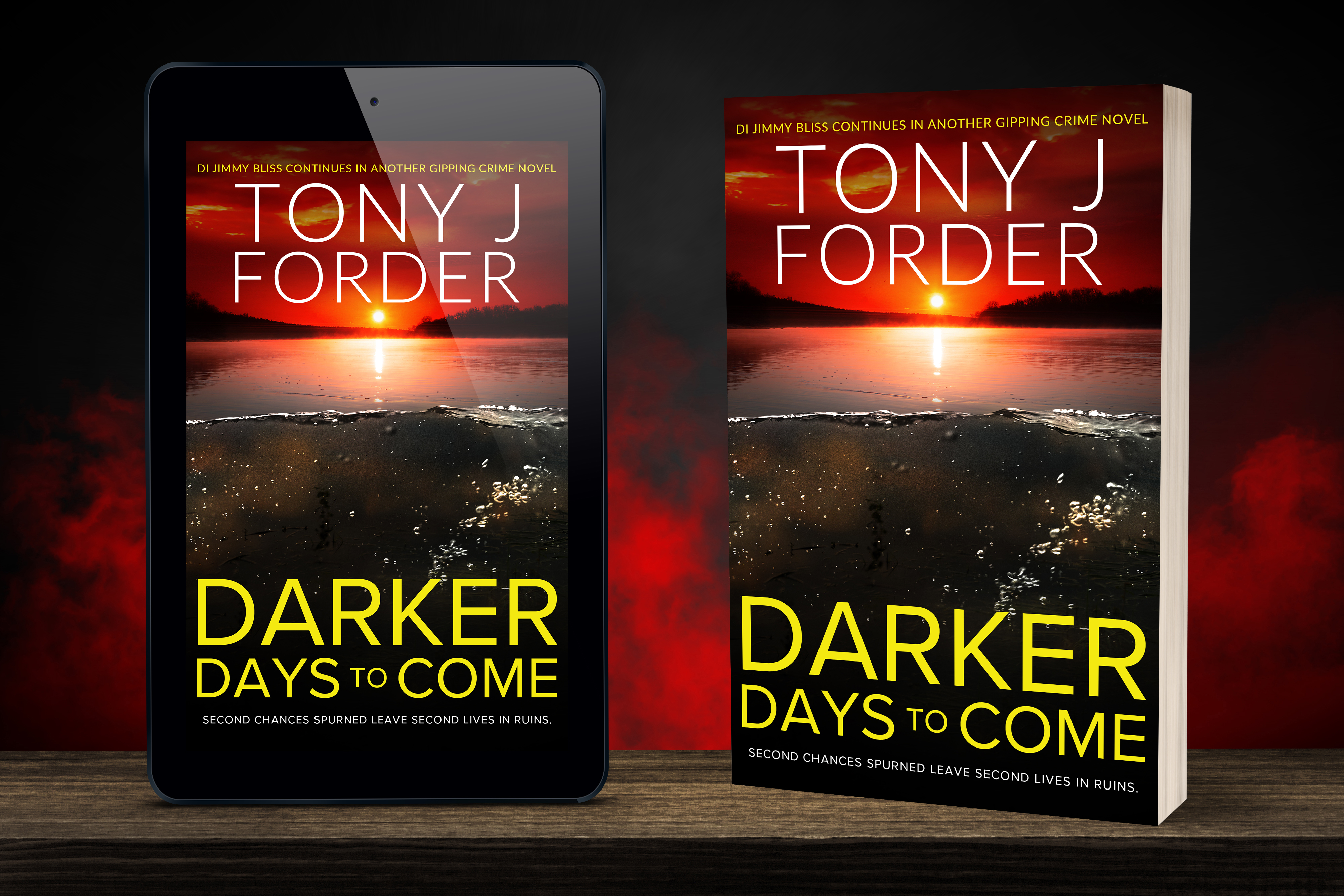
Darker Days to Come: getbook.at/DDtC
Interview
Many thanks for the opportunity, Sean.
What inspired you to become an author?
TJF: A book by Alan Garner called The Weirdstone of Brisingamen. I was an avid – perhaps even precocious – reader as a child, but it was only when I read this fantasy novel that I realised as a writer you could literally write about anything. It was inspirational, as well as a thrilling, magical tale. Later I realised it was kind of a Lord of the Rings-Lite, but the characters are more accessible for the young.
If you could choose one actor to play the role of one of you characters who would it be and why?
TJF: My best known character is DI Jimmy Bliss. In my head he was an amalgam of various men I knew or had seen acting (in the books he’s likened to Ray Winstone, and one reoccurring character always refers to him as Ray). But one day I was watching an episode of Elementary, a US spin on Sherlock Holmes, and Shaun Pertwee played Inspector Lestrade. His look and voice were perfect for Bliss.
Who is generally the target audiences for your books?
TJF: My demographic audience appears to be 40+ females. Taking it wider than who my ads target, I like to think my books will interest those who like a procedural, with developing characters, complex plots, together with plenty of thrills and some turns of darkness as well as natural humour in the dialogue.
Have you ever taken something that has happened in your life whether it be good or bad and used that as the plot of a novel you have wrote?
TJF: Not a whole plot, no, although I have used snippets from my own life and real-life stories I’ve heard from family and friends. Jimmy Bliss, for instance is a Chelsea supporter like me, and he enjoys the same eclectic taste in music. I did work with somebody who was, to say the least, odd. Myself and others often wondered what he might be like if he went off the deep end, and I used that as a springboard to make him the villain in my second Bliss book, The Scent of Guilt.
What is the best advice you can give an aspiring author?
TJF: Begin by knowing your market and deciding what you want from the end result – do you want to go traditional, with an indie publisher, or on your own. When you write, get the story out of your head. The real book gets written in the edits, so rely on them to mould what you have in your first draft. You’ll need a thick skin, the ability to bounce back from adversity, and plenty of determination.
You have options in publishing going self published vs standard publishers. I am sure both have benefits. What did you start with? What do you prefer?
TJF: My first 8 books were through a publisher. Other than providing some sort of validity, a publisher is often more capable of getting a wider audience for an author. They can pay for enticing covers, promotions, advertising, and the kind of overall exposure an individual starting out probably can’t afford, even if they have any idea where to start. The publisher has contacts and they can get them working on your behalf. But there are publishers who do little of this for you, and if that wider audience doesn’t materialise and if the publisher doesn’t seem to be working for you, then yes, there are other ways forward. I’ve now been publishing my own work since 2020, and while it’s hard graft and lots of hours doing the business side, in my experience it’s been hugely worthwhile. I enjoy the freedom it gives me, to choose my titles, my covers, my editors, my prices, my deadlines. That, to me at least, is worth its weight in gold.
Tell me about your writing process.
TJF: Usually it’s a fairly rigid one. The ideas have to come first, and I keep them all in a notebook actually marked ‘BIG BOOK OF IDEAS’. These range from a few lines to a few pages per idea. I tend to write what I have in my head at the time, the germ of a storyline essentially, and then come back a few weeks later to see if what I’ve written sparks further material. More often than not, it’ll be one of these ideas that eventually becomes my work in progress.
When writing, I tend to focus on that WIP for between 6-8 hours a day, 5 days a week. I write with the intention of getting the story out of my head so that it forms the first draft. A few weeks later I’ll return to it and begin my edits. The first edit is where the real book is written. I’ll plug any gaps, close any loopholes, reshape scenes, add scenes, remove scenes, do the same with subplots and even characters if necessary. Here I am adding flesh to the skeletal story. As a pantster I will often find myself having to rewrite early scenes in order to be consistent with those that came later, but I enjoy this stage and I also find it helps me focus on the book in its entirety. I spend fewer hours per day editing because I usually end up scanning as opposed to reading, so quite often this is when I’ll catch up on business or even develop the next WIP.
Other than the manuscript itself, I make notes along the way. I have an A4 lined book for each novel, with a full list of characters and 1-2 pages for each chapter. Each is a mini synopsis of that chapter, together with bullet points to remind me of specific events or issues I have to return to. I also keep a separate notebook for what I call ‘pickups’ – these are minor threads in need of attention. After the first edit I’ll usually do at least 3-4 more, paying greater attention to dialogue and finally grammar. Last thing before I send it out to beta readers is to send to my kindle for a final read through.
If you had the chance to co author with anyone who would you choose?
TJF: I’m far too much of a control freak to co-author anything, but if I had the opportunity it would be an honour to work with Michael Connelly, whose Harry Bosch character is my favourite detective.
 Crazy Canadian Writing