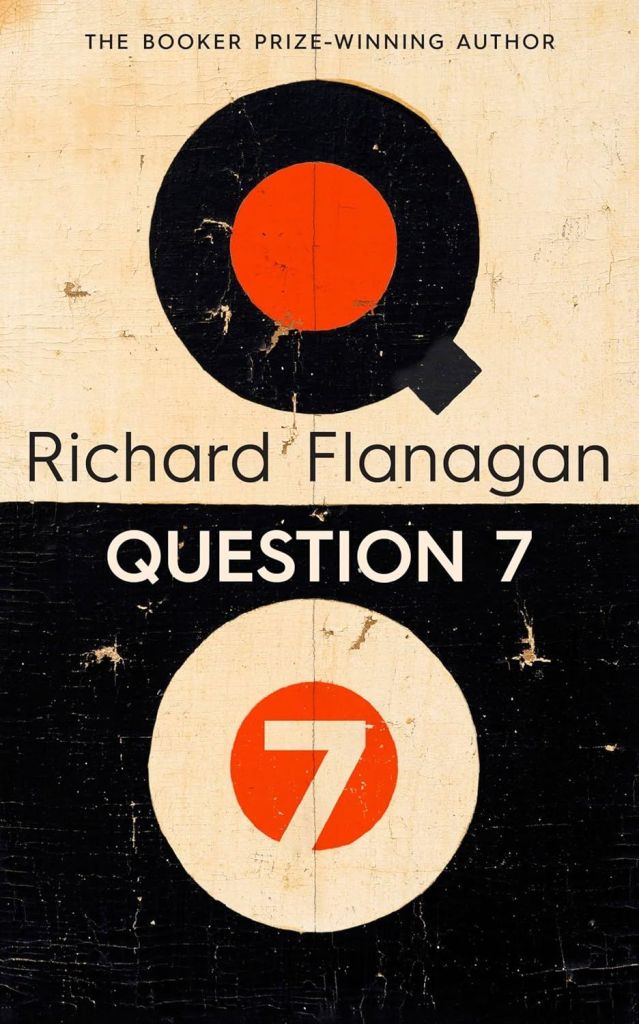
Blurb
By way of H. G. Wells and Rebecca West’s affair through 1930s nuclear physics to Flanagan’s father working as a slave labourer near Hiroshima when the atom bomb is dropped, this genre-defying daisy chain of events reaches fission when Flanagan as a young man finds himself trapped in a rapid on a wild river not knowing if he is to live or to die.
At once a love song to his island home and to his parents, this hypnotic melding of dream, history, literature, place and memory is about how reality is never made by realists and how our lives so often arise out of the stories of others and the stories we invent about ourselves.

About the Author
Richard Miller Flanagan (born 1961) is an Australian novelist from Tasmania. “Considered by many to be the finest Australian novelist of his generation”, according to The Economist, each of his novels has attracted major praise and received numerous awards and honors. He also has written and directed feature films. He won the 2014 Man Booker Prize.

My thoughts
First I want the thank The Publisher as well as Random Things Tours for the opportunity read this book.
The book is very interesting and definitely not what I was thinking. I was expecting something much more gritty but was pleasantly surprised and found this book such a refreshing change of pace. Reading up about this book it’s a memoir which shows what his life has been like. I enjoyed this since it does show how versatile the author is.
I love a good book that deals with historical issues such as the World Wars. I especially like when it doesn’t always deal with the the Holocaust. Again as a memoir this will be about his past and that or his family who probably weren’t involved in the Holocaust.
The story has such beautiful writing which shows so many different facets of what this author can do. Richard Flanagan has the earmarks of one of the best authors around especially with literary fiction and historical fiction. The fact that he can also write memoirs about his own life and his family is amazing.
Reading this book I see a lot of sides of the stories that I may not have thought about before. In one section he talks about not wanting to meet with those who were children during the war and were survivors. I can see how this could be hard to deal with the meeting of the people as they had suffered so much during the war and it could easily be a guilty mental state as well that they have it much easier.
This book has a very haunting overtone as you see the results of war through the eyes of the son of a POW. That in itself is sad enough but you feel so horrible not just for Richard but his father who now would have been diagnosed with PTSD or other health issues due to his captivity.
The father when he talks about him it feels very distant as though there really isn’t the same type of relationship that most of us will have with our father. The emotional attachment feels almost as if it doesn’t exist even though you can tell he loves his father dearly
I was impressed by the way this was written and I think that this author has a way to bringing you into his life and story. There are just so many poignant moments in this book that you have to feel for what all of the people talked about went through.
 Crazy Canadian Writing