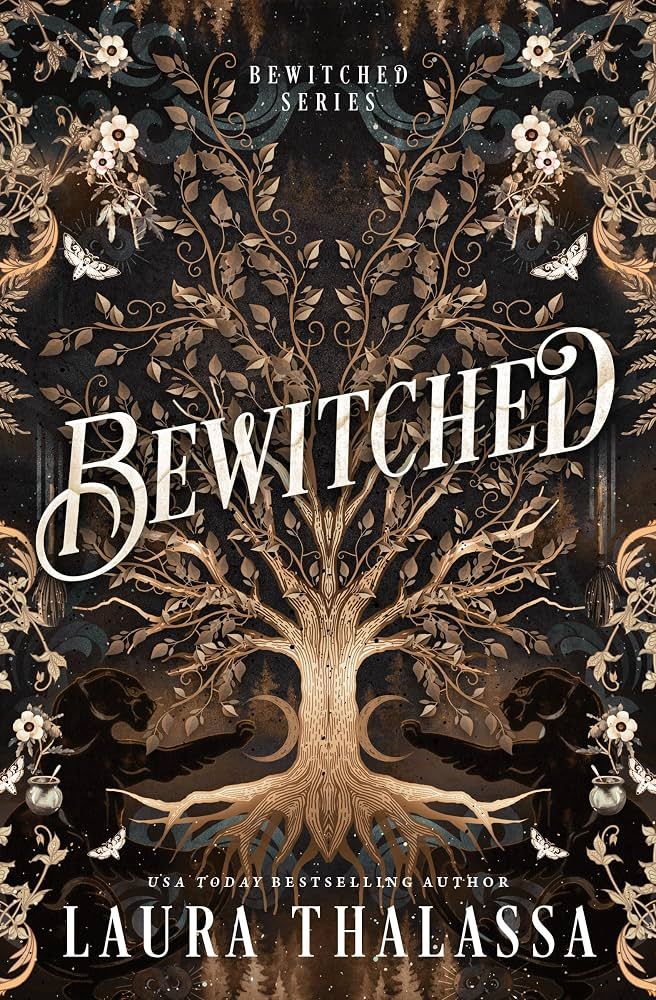
There are books that draw you in from the very first page. This isn’t necessarily one of them.
The opening is slower, but I don’t think that’s entirely a bad thing. It gives the reader time to settle into the story, become familiar with the author’s writing style, and begin understanding the world being built.
One of the elements that immediately caught my attention was the magic system. Magic always has a cost, and for the main character, Selene, that cost is her memories.
I found this concept incredibly interesting. After reading more than 3,000 books, it’s not often that I come across a consequence for using magic that feels genuinely different. Trading memories for power certainly caught my attention, particularly because it raises an intriguing question: How much of yourself would you be willing to sacrifice for power?
Selene desperately wants to become part of the Henbane Coven, a school for magic. She wants it badly enough that she’s willing to risk losing her memories if that’s what it takes to be accepted.
The story also introduces magical quests that must be completed, particularly for those hoping to join the coven. This brings some familiar fantasy tropes into the story, but they’re tropes I personally enjoy.
Quests are something I associate heavily with high fantasy and LitRPG. When done well, they’re a great way to move a story forward while providing characters with meaningful challenges and opportunities for growth. Seeing that concept incorporated into a more urban fantasy setting was something I really enjoyed.
My biggest issue, however, is Selene herself.
Despite memory loss being presented as a significant weakness, Selene often feels extremely overpowered. Many things seem to come too easily for her, and because of that, I rarely felt as though she truly struggled to earn her victories. If a character possesses an extraordinary amount of power, I want the consequences and challenges surrounding that power to feel equally significant.
More importantly, as the story progresses, I found some of Selene’s decisions increasingly difficult to reconcile with the character we’ve been presented with.
Her relationships with Memnon and Kane are a major part of this.
Memnon became one of the more interesting characters in the story, although not necessarily because I liked him. He appears willing to do almost anything for Selene, whom he believes is his “Roxi.” There is something deeply unsettling about his behaviour. His devotion increasingly comes across as possessive rather than romantic, and his attempts to influence Selene and prevent her from developing relationships with other people give his actions a controlling and obsessive quality.
As a character, this actually makes Memnon interesting to read because I found myself questioning his motives and wondering exactly what he wanted from Selene. As a potential romantic interest, however, I found him increasingly difficult to support.
Kane presents a different problem.
He’s a shifter, which should immediately open the door to some fascinating supernatural elements, yet I felt very little was done with that aspect of his character. I wanted to understand what being a shifter actually means for him. How does it affect the way he thinks? What instincts does he struggle with? What abilities does he possess? How does his supernatural nature influence his relationships?
Instead, much of his characterization seems centred around his sexual interest in Selene. For me, that feels like a missed opportunity. There is potentially much more to explore with Kane, and I would have liked to see the shifter side of his character become something meaningful rather than simply an interesting label attached to him.
This brings me back to Selene.
I struggled with her as a protagonist because she sometimes feels surprisingly passive in situations where I would expect her to demonstrate more independence. She clearly has feelings for Kane, yet she continues to be drawn toward Memnon despite the increasingly troubling nature of his behaviour.
Characters absolutely should make bad decisions. In fact, flawed decisions can make characters far more believable. My problem isn’t simply that Selene makes choices I disagree with; it’s that some of those choices don’t always feel consistent with the character the story has established.
There are moments when she seems strong, powerful, and determined, yet in her relationships she can suddenly become remarkably easy to influence. That disconnect made it harder for me to connect with her.
I was also somewhat disappointed by the lack of memorable supporting characters early in the story. I love strong secondary characters—the ones who make you laugh, frustrate you, surprise you, or leave you questioning whether they can actually be trusted.
Selene dominates so much of the narrative that I never formed the same connection with many of the characters surrounding her. Memnon eventually changed that, although largely because his behaviour created such a strong reaction.
Another issue I had was that certain parts of the story could be confusing. There are moments that seem to suggest Selene may be connected to another world, another existence, or perhaps another version of herself, and the repeated references to her as Roxilana add another layer that isn’t immediately clear.
Mystery can certainly strengthen a fantasy story, but there is a difference between deliberately withholding information and leaving the reader unsure of what is actually happening. At times, I found myself wondering whether I had missed an important detail or whether the confusion was intentional. This made it more difficult for me to become completely immersed in the story.
There are still genuinely interesting ideas here.
The slower beginning won’t work for everyone, but the magic system has a fascinating cost, and I enjoyed seeing traditional fantasy quest elements incorporated into a more urban fantasy setting. Memnon also developed into a character who created a strong emotional reaction, which can be a sign that a character is doing something effective within the story—even when that reaction is dislike.
Unfortunately, I ultimately felt that many of the story’s strongest ideas never fully came together.
I particularly wanted the story to make Selene struggle more.
If her magic costs her memories, I wanted that cost to hurt. I wanted her victories to feel earned. I wanted losing pieces of herself to have consequences that went beyond simply being an interesting mechanic of the magic system.
I also wanted her relationships to challenge her without diminishing her agency. I wanted Kane to become more than the shifter who desires her, and I wanted to understand whether Memnon’s obsession with “Roxi” was love, manipulation, something more sinister, or perhaps a complicated combination of all three.
Because if Selene is truly willing to sacrifice who she is to become who she wants to be, that has the potential to be one of the most powerful aspects of the entire story.
Unfortunately, by the end, I was left with more frustrations than answers.
The ending feels very much like the conclusion of a book rather than the conclusion of a story. Numerous questions and plot threads remain unresolved, clearly leaving room for the next instalment. While that isn’t necessarily a problem in a series, I didn’t feel enough emotional investment in the characters or larger story to make those unanswered questions compelling enough for me to continue.
The writing itself is well done, and there are certainly creative ideas throughout the book. My difficulty was never primarily with the author’s writing ability; it was with my connection to the story and its characters.
Romantasy is also not generally my preferred genre, particularly when the romantic and sexual elements begin to overshadow the fantasy elements and character development. Readers who enjoy complicated romantic relationships, morally questionable love interests, significant sexual content, and unusual magical systems may have a very different experience with this book.
For me, however, the characters never became solid enough to create the emotional connection I needed.
Would I read the next book?
No.
This wasn’t a book I hated. In some ways, that made my final reaction more disappointing. There were ideas I genuinely liked, especially the concept of sacrificing memories to use magic, but those ideas weren’t enough to overcome my lack of connection with the characters and story.
For readers looking for a romantasy with a unique magical cost, complicated relationships, morally questionable romantic choices, and a heavy emphasis on sexual attraction, there may be plenty here to enjoy.
For me, though, the balance between romance, sexuality, character development, and fantasy simply didn’t work.
The most interesting question the story raised was how much of herself Selene would sacrifice in pursuit of power.
By the end, I found myself asking a slightly different question:
If Selene continues losing pieces of herself, will there eventually be enough of her left for the reader to care about?

